
Why Sound Matters: Music, Nature, and Conversation in Restaurants
Why Sound Matters: Music, Nature, and Conversation in Restaurants
Sound in restaurants is the acoustic environment created by music, natural elements, and human conversation that directly shapes how guests perceive flavor, mood, and connection during a meal. This guide covers how acoustics alter the dining experience, the specific role music plays in pacing and atmosphere, why natural sounds reduce stress and encourage social interaction, what makes conversation the most valued sound at the table, and how restaurant design determines what guests actually hear.
Background noise does far more than create ambiance. Loud environments suppress sweetness and saltiness in food while amplifying umami, meaning the same dish tastes measurably different depending on decibel levels. Excessive volume also triggers a self-reinforcing cycle where diners raise their voices, which raises the noise floor for everyone nearby.
Music tempo, genre, and volume each function as levers that control dining pace and spending. Slower tempos between 60 and 80 BPM encourage guests to linger and order more, while faster tracks accelerate turnover. Live performances introduce dynamic energy that playlists cannot replicate, though they also create acoustic variability that requires careful management.
Birdsong, wind through tree canopies, and water ambience activate restorative responses that enclosed spaces cannot provide. Open-air settings rich in these sounds increase social interaction and create a sense of place no speaker system can reproduce.
Conversation quality consistently ranks as a core measure of dining satisfaction, yet noise remains the top complaint among restaurant guests. Material choices, spatial layout, and landscaping determine whether speech stays clear or gets buried under competing sound layers.
How Does Sound Shape the Overall Restaurant Dining Experience?
Sound shapes the overall restaurant dining experience by influencing taste perception, dwell time, and emotional comfort simultaneously. Environmental sounds carry meanings and contextual information that define how guests perceive a place, from the first impression to the final bite.
How Does Background Noise Level Affect Taste Perception?
Background noise level affects taste perception through crossmodal associations between audition and the gustatory system. Taste perception plays a central role in determining food preference, and what guests hear while eating actively alters how flavors register on the palate.
According to research reported by Time Magazine, sweet taste intensity was rated as lower and umami taste was rated as more pronounced in loud noise environments compared to quiet conditions. The EPA calculated the safe public noise level at a 70-decibel time-weighted average over 24 hours to prevent hearing loss. Restaurants that exceed this threshold risk more than guest discomfort; they compromise flavor experience itself.
Excessive noise also degrades cognitive function. Mental workload and auditory attention are significantly reduced at 95 dBA exposure levels, meaning diners in loud rooms struggle to focus on both conversation and food. The Lombard effect compounds this problem: vocal effort involuntarily doubles its rate of increase as background noise rises, creating a self-reinforcing cycle of escalating volume. Keeping levels below 50 dB(A) allows senior customers to minimize vocal strain while maximizing their willingness to spend time and money.
How Does Sound Influence How Long Diners Stay at a Table?
Sound influences how long diners stay at a table by setting the subconscious pace of the meal. Harsh, reverberant acoustics push guests to finish quickly and leave, while softer soundscapes encourage lingering.
One often-overlooked strategy involves living plants as acoustic tools. A study published in Building and Environment found that Boston Fern and Baby Tears plants, measured in the 50 to 1600 Hz frequency range, showed sound absorption properties suitable for indoor acoustic applications, with leaf area density closely related to flow resistivity. Integrating greenery into a dining room does double duty: it softens reflective noise that shortens visits and creates visual warmth that makes guests want to stay. For restaurants seeking longer table times and higher per-guest spending, acoustic comfort through natural materials is one of the most cost-effective investments available.
How Does Acoustic Environment Affect Emotional Comfort While Dining?
The acoustic environment affects emotional comfort while dining by shaping the psychological relationship between guests and the space around them. Soundscape ecology, the study of acoustic relationships between living organisms and their environment, offers a useful framework for understanding why certain restaurants feel welcoming while others feel stressful.
A dining room filled with clattering plates and competing conversations triggers a low-level stress response, even when guests cannot consciously identify the source of their discomfort. Conversely, layered natural sounds, gentle music, and conversational murmur at comfortable levels create an acoustic environment that signals safety and relaxation. This emotional dimension is often the difference between a meal guests simply eat and one they genuinely remember.
Understanding how sound shapes perception, timing, and emotion reveals why the next consideration for any restaurant is the specific role music plays in the dining setting.
What Role Does Music Play in a Restaurant Setting?
Music plays a direct role in shaping dining pace, guest mood, social interaction, and overall atmosphere. The following sections explore how tempo, genre, volume, and performance format each influence the restaurant experience.
How Does Music Tempo Influence Dining Pace and Spending?
Music tempo influences dining pace and spending by altering how quickly guests eat, how long they linger, and how much they ultimately order. Fast-tempo music in the 110 to 130 BPM range increases customer movement and reduces dwell time, while slower tempos between 60 and 80 BPM create a relaxed atmosphere ideal for fine dining. According to Convection Consulting, this tempo-driven shift in pacing directly affects table turnover rates and per-guest revenue. For restaurants prioritizing a leisurely experience, slower playlists encourage guests to order additional courses, desserts, and drinks. Faster tempos, on the other hand, suit high-volume service periods where efficient turnover matters more than extended visits.
How Does Music Genre Set the Mood for Different Meal Occasions?
Music genre sets the mood for different meal occasions by triggering distinct emotional associations that align with the dining context. Jazz or bossa nova suits intimate dinners, while upbeat acoustic sets complement weekend brunch energy. According to a study published in the Food Quality and Preference Journal, listening to music during eating is associated with longer meals and higher food intake compared to silent conditions. Genre selection signals to guests what kind of experience to expect before they even read the menu. Matching the playlist to the occasion, whether a casual lunch or a celebratory dinner, reinforces the atmosphere a restaurant intends to create.
How Does Music Volume Change the Way Guests Interact?
Music volume changes the way guests interact by determining whether conversation flows naturally or becomes strained. When volume stays moderate, music enhances the dining atmosphere without competing with speech. Louder levels force diners to raise their voices, which escalates overall noise through a feedback loop. Quieter settings allow tables to maintain conversational privacy while still benefiting from a curated sonic backdrop. The ideal balance keeps music perceptible enough to set a mood yet soft enough that guests never have to repeat themselves.
How Does Live Music Differ From Recorded Music in a Restaurant?
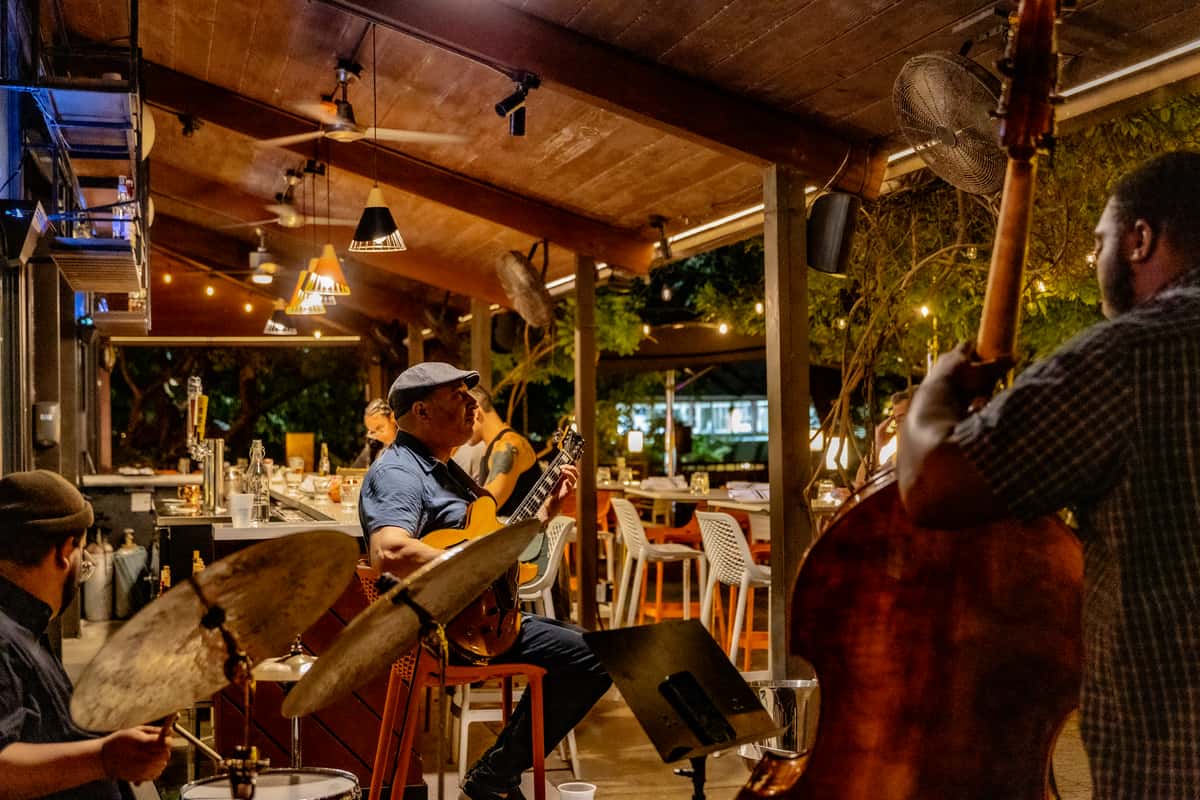
Live music differs from recorded music in a restaurant by introducing dynamic energy, visual engagement, and unpredictable variation that playlists cannot replicate. A live performer reads the room, adjusting tempo and volume to match the crowd's mood in real time. However, live sets also introduce acoustic variability; typical restaurant noise can fluctuate from 65 dB(A) up to 85 dB(A) over the course of an evening, and a live act can amplify those swings. Recorded music offers consistency and precise volume control, making it easier to maintain balanced acoustics throughout service. For restaurants with open-air settings, where sound dissipates naturally, live music often complements the space without the buildup issues common in enclosed rooms.
Why Are Natural Sounds Important in a Restaurant Environment?
Natural sounds are important in a restaurant environment because they reduce stress, encourage social connection, and create a sense of place that enhances the dining experience. The following sections explore how birdsong, wind, water, and open-air settings each contribute to this effect.
How Do Birdsong and Wildlife Sounds Enhance a Meal Outdoors?
Birdsong and wildlife sounds enhance a meal outdoors by grounding diners in the natural environment and creating a multisensory connection to place. Environmental sounds carry meanings and contextual information that shape how people experience a setting, according to research published in Frontiers in Psychology. Hearing birds or rustling wildlife signals openness, safety, and proximity to nature. These auditory cues shift attention away from urban stress and toward the present moment. For a restaurant nestled under a tree canopy, the ambient chorus of local wildlife becomes an organic layer of atmosphere that no speaker system can replicate.
How Does the Sound of Wind Through Trees Create Atmosphere?
The sound of wind through trees creates atmosphere by introducing gentle, irregular acoustic texture that feels calming and alive. Unlike mechanical white noise, wind moving through leaves produces soft, dynamic variation that the brain processes as a restorative natural signal. Biophilic design integrates natural elements into indoor environments to mitigate the negative effects of urbanization on human well-being, as described in a 2025 study published in Nature Scientific Reports. Wind through a canopy delivers this biophilic benefit passively, wrapping diners in a soundscape that feels unhurried. That organic rhythm encourages guests to slow down and settle into conversation.
This biophilic benefit is particularly evident in settings like Glass & Vine, where the mature oak canopy of Peacock Park provides continuous wind-through-leaves ambience throughout service, creating a restorative backdrop that enhances the all-day dining experience.
How Does Water and Ocean Ambience Affect Diner Relaxation?
Water and ocean ambience affects diner relaxation by activating the body's parasympathetic nervous system, which promotes calm. Flowing water produces consistent, low-frequency sound that masks sharper noises like clattering dishes or passing traffic. In a waterfront or garden setting, this natural masking effect softens the overall soundscape without requiring artificial intervention. For restaurants near Biscayne Bay or coastal parks, the subtle presence of water sound adds a layer of tranquility that pairs naturally with an unhurried meal. Few acoustic elements feel as universally soothing.
How Does Open-Air Dining Blend Natural Sound With the Meal?
Open-air dining blends natural sound with the meal by removing walls that would otherwise isolate guests from their surroundings. Without enclosed surfaces, sound disperses naturally rather than bouncing and accumulating. A study published in Landscape and Urban Planning found that natural sounds increase the percentage of people engaging in social interactions by roughly 10% and raise the frequency of group interactions in urban parks. This finding suggests that open-air environments rich in natural sound actively encourage the kind of relaxed, communal dining that guests value most. With natural acoustics shaping every meal, the role of intentional conversation becomes the next layer worth exploring.
What Makes Conversation the Most Valued Sound in a Restaurant?
Conversation is the most valued sound in a restaurant because dining is fundamentally a social activity. Table spacing, noise control, and acoustic design all determine whether guests can connect meaningfully over a meal.
How Does Table Spacing Affect Conversational Privacy?
Table spacing affects conversational privacy by controlling how much neighboring sound reaches each dining party. When tables sit too close together, overlapping voices force diners to raise their volume, which compounds the overall noise floor. Adequate separation creates a buffer zone where speech from adjacent tables fades below the threshold of intelligibility. This allows guests to speak at a natural, comfortable volume without straining or being overheard. For restaurants that prioritize connection, generous spacing between tables is one of the simplest and most effective acoustic strategies available.
How Does Excessive Noise Prevent Meaningful Conversation?
Excessive noise prevents meaningful conversation by forcing diners to compete with the surrounding sound environment. When background levels climb, speakers involuntarily raise their voices, which in turn raises the overall volume for everyone nearby. According to CDC/NIOSH guidelines, the recommended occupational noise exposure limit is 85 dBA over an eight-hour shift, yet many dining rooms approach or exceed this threshold during peak hours. At those levels, following a conversation across a table becomes physically exhausting. Guests lose the nuance of tone, humor, and emotion that make shared meals memorable. Rather than lingering, diners tend to cut visits short when verbal communication feels like a chore.
Why Do Diners Rate Conversation Quality as Part of Satisfaction?
Diners rate conversation quality as part of satisfaction because the ability to connect with companions defines whether a meal feels worthwhile. A beautifully plated dish loses its impact if guests cannot discuss and enjoy it together. Conversation transforms eating from a biological necessity into a social ritual, and when acoustic conditions undermine that exchange, the entire experience suffers. Restaurants that protect speech clarity signal to guests that their comfort and connection matter. For most people, the memory of a great restaurant centers less on individual flavors and more on the laughter, stories, and warmth shared at the table. Understanding how restaurants balance all these sound layers is the next consideration.
How Do Restaurants Balance Music, Nature, and Conversation?
Restaurants balance music, nature, and conversation by calibrating volume levels, choosing complementary sound sources, and designing spaces that let each layer coexist without competing. The following sections explore what happens when one element dominates.
What Happens When Music Overpowers Natural Ambience?
When music overpowers natural ambience, the environmental sounds that ground diners in a place lose their effect. Birdsong, rustling leaves, and distant water features get buried under amplified playlists, stripping an outdoor setting of the sensory depth that makes it memorable.
For restaurants like Glass & Vine, where dining unfolds beneath Peacock Park's oak canopy, the natural soundscape is part of the experience. Turning music volume even a few decibels too high can flatten that layered atmosphere into a generic backdrop. The most effective approach is treating music as a complement to nature, not a replacement, keeping instrumental levels low enough that organic sounds remain audible between phrases.
What Happens When Background Noise Drowns Out Conversation?
When background noise drowns out conversation, diners strain to hear companions, raise their voices, and ultimately enjoy both the meal and the company less. This vocal escalation creates a feedback loop where the entire room grows progressively louder.
The consequences extend beyond comfort. According to a 2022 Rockfon acoustics review, food's saltiness, sweetness, and overall liking diminished when eaten under noise conditions of 75 to 85 dB. Guests who are noise-sensitive may feel overwhelmed even at moderate levels, since sensitivity influences attention and recognition regardless of whether sound exceeds occupational thresholds. When conversation suffers, satisfaction drops across the board, affecting how guests perceive the food, the service, and the space itself.
How Do Outdoor Restaurants Manage Competing Sound Layers?
Outdoor restaurants manage competing sound layers by using spatial zoning, strategic speaker placement, and natural barriers that separate sound sources. Unlike enclosed dining rooms, open-air venues cannot rely on walls and ceilings to contain noise.
Effective approaches include:
- Positioning speakers at low heights and close intervals so music stays even without excessive volume.
- Using dense plantings and vertical gardens as natural sound buffers between dining zones.
- Placing louder social areas, such as bars, away from quieter tables meant for intimate conversation.
- Allowing ambient nature sounds to serve as the baseline, layering music softly on top.
Sound masking principles, as outlined by Cambridge Sound Management, help outdoor venues introduce gentle background sound that smooths abrupt noise spikes without adding perceptible volume. With these strategies in place, restaurant design choices become the next factor shaping what guests actually hear.
How Does Restaurant Design Affect Acoustics and Sound Quality?
Restaurant design affects acoustics and sound quality through material selection, spatial layout, and landscaping choices. The sections below explore how surfaces, open-air configurations, and canopy elements each shape the sonic environment.
How Do Hard Surfaces Versus Soft Materials Change Sound Levels?
Hard surfaces versus soft materials change sound levels by altering how sound waves reflect or absorb within a dining space. Hard materials like concrete, glass, and tile reflect sound waves, causing them to bounce repeatedly and amplify overall noise. Soft materials, including upholstered seating, fabric panels, and textured wall treatments, absorb sound energy and reduce reverberation.
This distinction carries real consequences for accessibility. According to the ADA National Network, people who are deaf or hard of hearing may need to exchange notes or use other methods to communicate and get information about menu items in restaurants. Excessive reverberation from hard surfaces makes this challenge significantly worse. Thoughtful material pairing, where reflective elements are balanced with absorptive ones, gives every guest a better chance at comfortable conversation.
How Does an Open-Air Layout Reduce Noise Buildup?
An open-air layout reduces noise buildup by allowing sound waves to disperse into the surrounding environment rather than reflecting off enclosed walls and ceilings. Without four walls trapping acoustic energy, reverberation time drops substantially, and the cumulative volume escalation common in indoor restaurants is naturally minimized.
Open-air spaces also benefit from ambient environmental sounds that function as natural sound masking. According to Cambridge Sound Management, sound masking is the inclusion of generated sound into an environment to mask unwanted sound, relying on auditory masking to reduce noise distractions and protect speech privacy. In an outdoor setting, wind, birdsong, and rustling foliage serve this masking role organically, softening conversational overlap without artificial intervention.
How Does Landscape and Canopy Design Absorb Ambient Noise?
Landscape and canopy design absorbs ambient noise by introducing dense organic structures that intercept and dissipate sound energy before it reaches diners. Tree canopies, hedgerows, and layered plantings create physical barriers that scatter sound waves across irregular surfaces, reducing their intensity.
Living foliage is particularly effective because leaf density directly correlates with acoustic absorption capacity. Strategically positioned greenery around a dining area can soften street noise, buffer conversations between tables, and lower the overall ambient volume guests experience. For a restaurant set beneath mature oaks and tropical plantings, these elements work continuously as passive acoustic treatment, requiring no mechanical systems. This natural acoustic management is one reason design choices increasingly shape how guests perceive sound quality at the table.
Why Is Sound a Growing Priority for Restaurant Guests Today?
Sound is a growing priority for restaurant guests today because noise consistently ranks among the top complaints in dining reviews, and a clear majority of diners now actively seek quieter venues. Below, two key trends illustrate this shift: the prominence of noise in online feedback and the rising preference for acoustically comfortable restaurants.
How Do Online Reviews Reflect Complaints About Restaurant Noise?
Online reviews reflect complaints about restaurant noise with increasing frequency, making acoustics one of the most discussed aspects of the dining experience. In 2018, a repeated restaurant survey published by Nature Scientific Reports revealed that noise was the primary complaint of restaurant patrons, surpassing concerns about food and service.
This pattern has only intensified as review platforms give diners a louder voice. According to the Quiet Communities National Restaurant Noise Survey, 46% of respondents said they would be much more likely to dine at a restaurant offering quiet hours, and 59% would recommend such a restaurant to friends and family. When nearly half of potential guests factor noise into their decision, restaurants that ignore acoustics risk losing both first-time visitors and repeat diners.
Why Are Diners Choosing Quieter Restaurants More Often?
Diners are choosing quieter restaurants more often because the gap between what guests want and what most venues deliver has become impossible to ignore. According to the Quiet Communities National Restaurant Noise Survey, 66% of respondents indicated that restaurants feel more like bars than a place to gather with friends and family.
That statistic reveals a fundamental mismatch. Guests visit restaurants primarily for connection, yet escalating volume levels undermine the very conversations they came to enjoy. As awareness of this disconnect grows, diners increasingly reward venues that prioritize acoustic comfort with their loyalty and word-of-mouth recommendations. For restaurants in settings that naturally support a calmer soundscape, this shift represents a significant competitive advantage.
Open-air venues like Glass & Vine in Coconut Grove benefit from this trend, as the natural acoustic dispersal beneath Peacock Park's canopy addresses guest demand for conversation-friendly dining without requiring artificial noise mitigation.
With guest expectations around sound rising steadily, restaurants that blend thoughtful design with natural surroundings can meet this demand from day one.
How Does an Open-Air Garden Setting Elevate the Sound Experience?
An open-air garden setting elevates the sound experience by replacing enclosed noise buildup with natural acoustic dispersal, layered birdsong, and gentle wind through tree canopies. The following sections explore how Glass & Vine achieves this in Coconut Grove and summarize the key reasons sound matters in restaurants.
Can Glass & Vine's Garden Dining in Coconut Grove Deliver a Natural Soundscape With Every Meal?
Yes, Glass & Vine's garden dining in Coconut Grove can deliver a natural soundscape with every meal. Situated beneath Peacock Park's mature oak canopy, the open-air layout allows sound to disperse naturally rather than bounce between hard walls. Guests hear wind filtering through overhead branches, birdsong from the surrounding park, and the subtle rhythm of nearby Biscayne Bay.
This layered natural soundscape keeps conversation clear without the amplified noise typical of enclosed dining rooms. The lush landscaping surrounding each table also contributes soft acoustic absorption, reducing sharp sound reflections. Glass & Vine pairs this environment with a relaxed, garden-inspired atmosphere where families, couples, and friends can linger over locally sourced dishes. For guests who value both culinary quality and sensory comfort, the Coconut Grove setting offers something most indoor restaurants simply cannot replicate.
What Are the Key Takeaways About Why Sound Matters in Restaurants?
The key takeaways about why sound matters in restaurants center on how acoustics shape taste, mood, conversation, and overall satisfaction:
- Background noise alters flavor perception. Loud environments suppress sweetness and saltiness while amplifying umami, meaning the same dish tastes different depending on decibel levels.
- Music tempo directly controls dining pace. Slower tempos encourage guests to stay longer and spend more, while fast-tempo tracks accelerate turnover.
- Natural sounds reduce stress and boost social interaction. Birdsong, rustling leaves, and water ambience activate restorative responses that enclosed spaces cannot provide.
- Conversation quality defines the dining memory. Most guests rank the ability to hear companions as a core measure of satisfaction, and excessive noise is consistently the top complaint.
- Design decisions determine acoustic outcomes. Open-air layouts, soft landscaping, and strategic spacing prevent the noise buildup that plagues hard-surfaced indoor restaurants.
Restaurants that treat sound as a design priority, not an afterthought, create experiences where food tastes better, guests feel calmer, and conversations flow without strain. Glass & Vine brings this philosophy to life in Coconut Grove, where the open-air garden setting beneath Peacock Park's canopy turns every meal into a multisensory experience shaped by nature itself.