
The Role of Light, Shade, and Greenery in Great Dining Experiences
The Role of Light, Shade, and Greenery in Great Dining Experiences
Light, shade, and greenery are the three environmental forces that shape how guests perceive flavor, form memories, and experience comfort during a meal. Together, they constitute a biophilic design system that influences dining satisfaction at the sensory, psychological, and neurological level.
This guide covers the science of natural light and appetite, strategic shade for outdoor comfort, the acoustic and psychological benefits of living greenery, how these elements function as an integrated design system, and what makes open-air garden dining genuinely memorable.
Natural light synchronizes circadian meal timing, enhances how food colors appear on the plate, and elevates mood through reduced stress responses. Different times of day produce distinct effects: bright midday sun energizes brunch, while golden hour warmth transforms dinner ambiance into something no fixed lighting scheme can replicate.
Shade determines whether outdoor dining is viable or unbearable, particularly in tropical climates like South Florida where extreme heat can render unprotected seating unusable for hours each day. Tree canopies, pergolas, and filtered shade each create different comfort profiles that extend a restaurant's functional service window.
Living plants absorb noise, filter air, and trigger measurable psychological relaxation by shifting the brain from directed focus into a restorative mode. Dense vegetation can cut perceived volume roughly in half, while biophilic exposure reduces fatigue, anxiety, and cognitive overload.
When layered together, these elements create a dining atmosphere that shifts naturally with the time of day and season, producing the kind of sensory richness that encodes stronger memories. Over half of restaurant-goers already prefer venues with outdoor dining areas, and the economics confirm that thoughtful open-air design generates outsized returns on investment.
Why Does the Dining Environment Matter as Much as the Food?
The dining environment matters as much as the food because it shapes emotion, comfort, and memory before a single dish arrives. Sensory elements like natural light, shade, and surrounding greenery influence how guests perceive flavor, regulate mood, and form lasting impressions of a meal. According to a UCLA economic analysis, San Pedro's 13 restaurants participating in L.A. Al Fresco increased gross sales from $4 million in 2019 to $11 million in 2022, demonstrating that environment directly drives both guest preference and revenue. When atmosphere falls short, even exceptional cuisine struggles to leave a positive mark. The sections below explore how light conditions, shade strategies, and living greenery each contribute to a dining experience that resonates long after the check is paid.
How Does Natural Light Influence the Way Diners Experience a Meal?
Natural light influences the way diners experience a meal by regulating appetite, enhancing food appearance, and shaping emotional tone throughout the dining occasion. The sections below explore how different times of day, light quality, and daylight exposure each contribute to this effect.
How Does Morning and Midday Sunlight Enhance Brunch and Lunch?
Morning and midday sunlight enhance brunch and lunch by delivering bright, full-spectrum light that promotes alertness and supports natural appetite cues. According to research published by Taylor & Francis Online, exposure to natural light synchronizes circadian meal timing and improves appetite regulation through photoentrainment of the suprachiasmatic nucleus. This biological alignment means a sunlit brunch table does more than look inviting; it primes the body to eat at the right time. Bright midday light also renders dishes with high color fidelity, so vibrant ingredients appear at their most appetizing. For restaurants offering daytime service, positioning tables where unfiltered morning and midday sun reaches the plate creates a measurable physiological advantage.
How Does Golden Hour and Sunset Light Transform Dinner Ambiance?
Golden hour and sunset light transform dinner ambiance by casting warm, low-angle illumination that softens shadows and bathes the dining space in amber and rose tones. This natural warmth mimics the color temperatures associated with relaxation and emotional comfort. Skin tones appear warmer, table settings glow, and the overall environment shifts from energetic to intimate within minutes. For evening-focused restaurants, the transition from golden hour into twilight creates a dynamic atmosphere that no fixed lighting scheme can replicate. Timing the seating of early dinner guests to coincide with this window is one of the simplest ways to elevate perceived ambiance without any design investment.
How Does Natural Light Affect the Perception of Food Color and Freshness?
Natural light affects the perception of food color and freshness by rendering the full visible spectrum, which allows diners to see true pigment intensity in ingredients. Under artificial alternatives, colors shift noticeably. According to a study published in the MDPI Foods Journal on food emotional perception and lighting colors, warm lighting (incandescent) enhances consumer perception of food color favorability compared to fluorescent and metal halide lighting, particularly for meat products. Natural daylight surpasses even warm artificial sources in spectral completeness, making greens appear more vibrant, proteins richer, and sauces more saturated. When dishes look fresh, diners trust the quality before tasting a single bite.
How Does Daylight Exposure Influence Mood and Appetite at the Table?
Daylight exposure influences mood and appetite at the table by reducing stress hormones and increasing positive emotional states that make diners more receptive to food. A study published in Frontiers in Psychology found that the restorative influence of environmental qualities, including vegetation and biophilic architecture, decreased negative mood experiences and perceived stress while increasing positive mood states. Elevated mood naturally supports appetite; guests who feel relaxed and content tend to order more, linger longer, and associate the meal with pleasure rather than routine. This connection between daylight, mood, and appetite is especially pronounced in open-air settings where sunlight works alongside surrounding greenery. Understanding how shade structures complement this natural light helps maintain comfort as conditions shift throughout the day.
How Does Shade Create Comfort in Outdoor Dining Spaces?
Shade creates comfort in outdoor dining spaces by reducing direct solar exposure, lowering ambient temperature, and allowing guests to linger without heat-related discomfort. Tree canopies, pergolas, architectural overhangs, and filtered shade each contribute differently to the guest experience.
How Do Tree Canopies Provide Natural Climate Control for Diners?
Tree canopies provide natural climate control for diners by intercepting solar radiation before it reaches the seating area, reducing surface temperatures beneath the canopy by several degrees compared to unshaded pavement. Large broadleaf species, such as live oaks, create a microclimate effect: leaves absorb and reflect sunlight while transpiration releases moisture that cools surrounding air. This passive cooling process requires no mechanical energy, making mature canopy trees one of the most efficient shade solutions for outdoor restaurants. For venues in warm climates, preserving and building around existing canopy trees is often more effective than any engineered alternative.
How Do Pergolas and Architectural Overhangs Balance Light and Shade?
Pergolas and architectural overhangs balance light and shade by creating partial coverage that blocks overhead sun while still permitting ambient daylight and airflow. Pergolas use open-lattice or slatted roof structures, casting rhythmic shadow patterns that shift throughout the day. Architectural overhangs extend from building facades at calculated angles, shielding diners from direct sun during peak hours while allowing lower-angle morning and evening light to reach the table. The key advantage of both structures is controllability; operators can add retractable fabric, climbing vines, or adjustable louvers to fine-tune the ratio of light to shade based on season and time of day.
How Does Filtered Shade Differ From Full Shade in Guest Comfort?
Filtered shade differs from full shade in guest comfort by allowing intermittent sunlight to pass through gaps in foliage or lattice, creating dappled light patterns rather than uniform darkness. Full shade blocks nearly all direct sunlight, which maximizes cooling but can feel dim or enclosed. Filtered shade, by contrast, maintains a connection to the outdoor environment; guests perceive brightness, warmth, and visual texture without the intensity of unobstructed sun. This balance tends to encourage longer dwell times, as diners feel comfortably sheltered yet still immersed in the natural setting. For most outdoor dining scenarios, filtered shade strikes a better balance than full enclosure.
Why Is Strategic Shade Placement Critical in Tropical Climates?
Strategic shade placement is critical in tropical climates because near-equatorial sun angles produce intense overhead radiation for most of the year, and humidity limits the body's ability to cool through evaporation. According to the Miami-Dade County Extreme Heat Program, South Florida experienced an unprecedented 60 days with a heat index at or above 105°F in 2024. Under these conditions, unshaded outdoor seating becomes unusable during midday hours. Positioning shade structures to cover primary dining zones from 11 a.m. through 3 p.m., when solar intensity peaks, extends the functional service window significantly. In tropical markets, shade is not a design accent; it is an operational necessity that directly determines guest capacity and revenue potential.
Understanding how shade shapes comfort outdoors sets the stage for exploring how greenery further elevates the restaurant setting.
What Role Does Greenery Play in Elevating a Restaurant Setting?
Greenery elevates a restaurant setting by absorbing noise, filtering air, reducing stress, and anchoring the space in its local environment. The following subsections cover acoustic benefits of living plants, air quality improvements, psychological relaxation effects, and how tropical vegetation defines a South Florida sense of place.
How Do Living Plants Reduce Noise and Create Acoustic Intimacy?
Living plants reduce noise and create acoustic intimacy by absorbing, deflecting, and diffusing sound waves across their leaves, branches, and soil. Dense foliage acts as a natural buffer between tables, softening the clatter of dishware and overlapping conversations that can otherwise overwhelm an outdoor dining space.
According to Gardening Know How, dense, full-height vegetation can reduce sound by 5 to 10 dB when paired with solid barriers, while a berm combined with plant material cuts noise by 6 to 15 decibels, roughly halving the perceived volume. For open-air restaurants, this means strategically placed hedges and vertical plantings between seating zones can replicate the conversational privacy diners typically associate with enclosed rooms. The result is a setting where guests hear each other clearly without raising their voices.
How Does Surrounding Vegetation Improve Air Quality for Diners?
Surrounding vegetation improves air quality for diners by filtering airborne particulates, absorbing carbon dioxide, and releasing oxygen through photosynthesis. Broad-leafed tropical plants are particularly effective at trapping dust, pollen, and vehicle exhaust particles before they reach the table.
In an open-air setting like Coconut Grove, where street traffic and coastal humidity interact, a well-planned plant border serves as a living filtration system. Palms, ficus hedges, and understory ferns each capture pollutants at different heights, creating layered purification. Cleaner air sharpens the perception of aromas from the kitchen, allowing guests to fully appreciate the fragrance of fresh ingredients. This invisible benefit is one of the most practical reasons landscaped restaurants feel noticeably more pleasant than bare patios.
How Does Lush Landscaping Trigger Psychological Relaxation?
Lush landscaping triggers psychological relaxation by activating the brain's involuntary attention system, allowing the prefrontal cortex to recover from mental fatigue. Surrounded by foliage, diners shift from directed focus into a softer, restorative mode of awareness.
Research supports this effect at the neurological level. A 2025 study published in the MDPI International Journal of Environmental Research and Public Health found that brief exposure to biophilically designed environments produced decreases in fatigue, depression, and anxiety, alongside increases in vigor, attentiveness, and perceived restorativeness compared to plain control conditions. For restaurant guests, this translates into longer, more relaxed meals where conversation flows naturally. Landscaping does not just decorate a space; it actively recalibrates the nervous system toward comfort.
How Does Tropical Greenery Establish a Sense of Place in South Florida?
Tropical greenery establishes a sense of place in South Florida by connecting a restaurant's atmosphere to the region's native landscape, climate, and cultural identity. Palms, bougainvillea, bird of paradise, and frangipani signal to guests that they are dining in a distinctly subtropical environment, not a generic patio.
This regional anchoring carries practical weight as well. According to the Miami-Dade County Extreme Heat Program, South Florida experienced an unprecedented 60 days with a heat index at or above 105°F in 2024. Dense tropical canopy and layered vegetation provide essential cooling through evapotranspiration, making outdoor dining viable even during peak summer months. In Coconut Grove, where lush tree cover defines the neighborhood's character, tropical plantings transform a restaurant from a place that happens to be outdoors into one that belongs outdoors.
With greenery shaping both comfort and identity, these natural elements become part of a larger design system alongside light and shade.
How Do Light, Shade, and Greenery Work Together as a Design System?
Light, shade, and greenery work together as a design system by creating layered environmental conditions that simultaneously shape mood, comfort, and sensory perception. The subsections below explore canopy-lighting synergy, dappled light and foliage intimacy, and seasonal atmospheric shifts.
How Does Layering Canopy Shade With Ambient Lighting Set Mood?
Layering canopy shade with ambient lighting sets mood by filtering harsh sunlight through tree cover while supplementing with warm-toned fixtures that guide emotional tone across the dining space. Overhead branches establish a soft, diffused baseline of natural light, and strategically placed warm lighting fills the gaps as daylight fades.
Color temperature is the critical variable in this balance. According to a study published in the MDPI Foods Journal on food emotional perception and lighting colors, blue light evoked the strongest "sad" emotion (M = 0.39) among all lighting types and induced negative emotions with lower appetite compared to warm lighting. This finding underscores why restaurants benefit from pairing canopy shade, which naturally filters cooler wavelengths, with warm ambient sources that sustain positive emotional states. The result is a seamless transition from afternoon to evening that never jars the guest's sense of ease.
How Does the Interplay of Dappled Light and Foliage Create Intimacy?
The interplay of dappled light and foliage creates intimacy by breaking open sightlines into smaller, enclosed visual zones. When sunlight passes through layered leaves, it fragments into shifting patterns on surfaces and skin, drawing attention inward toward the table rather than outward toward surrounding activity.
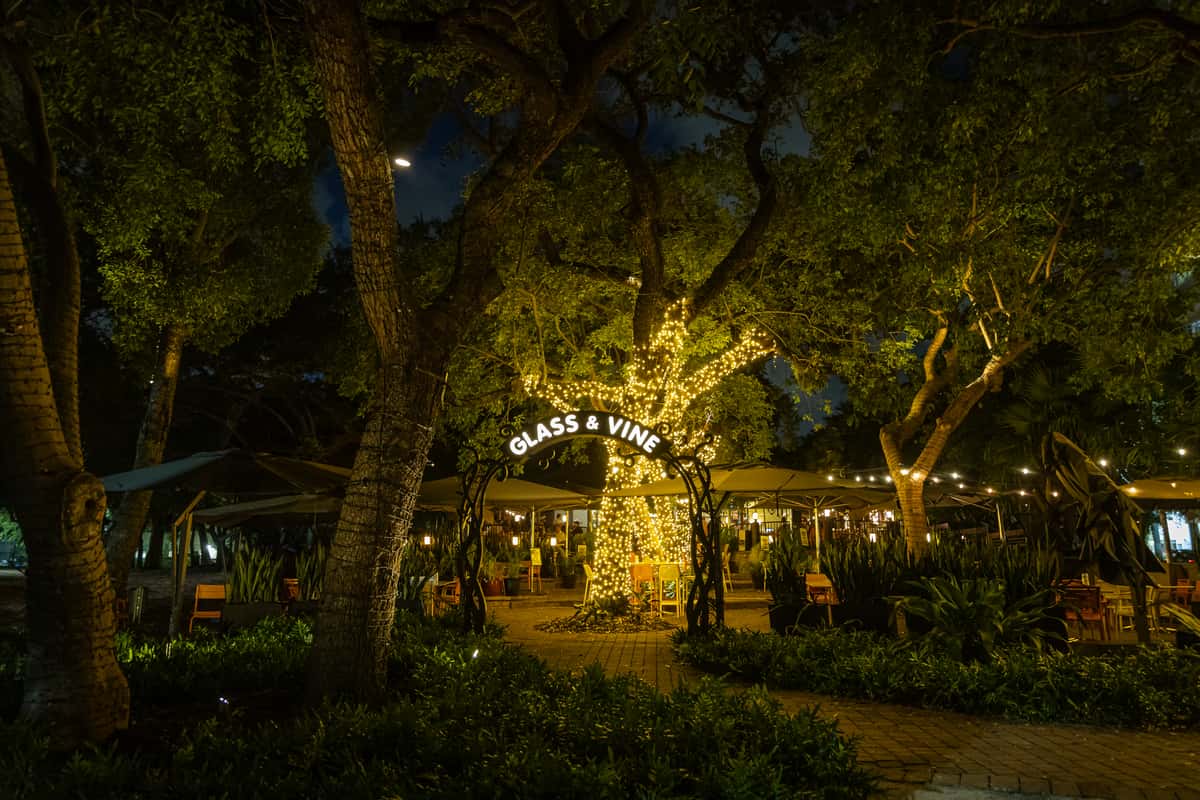
In Coconut Grove, Glass & Vine demonstrates this principle through its positioning beneath Peacock Park's mature oak canopy, where dappled light filters through layered foliage to create distinct zones throughout the dining area. The restaurant also welcomes families and offers a dog-friendly menu, making the garden setting accessible for varied guest experiences.
How Do Seasonal and Time-of-Day Shifts Change the Dining Atmosphere?
Seasonal and time-of-day shifts change the dining atmosphere by altering the angle, intensity, and warmth of natural light passing through the canopy. In summer, high sun angles produce tighter shade pools and brighter contrast, while winter's lower trajectory sends longer golden light deeper beneath tree cover.
Time of day amplifies these changes:
- Morning light arrives cool and directional, energizing brunch with crisp visibility.
- Midday sun intensifies overhead, making dense canopy shade essential for comfort.
- Golden hour bathes foliage in amber tones, softening every surface.
- Post-sunset, ambient fixtures take over, and the greenery becomes a textured backdrop rather than a light filter.
Restaurants that treat these shifts as design opportunities, rather than problems to solve, create spaces that feel alive and unrepeatable. Understanding this layered system is what makes open-air garden dining feel genuinely memorable.
Why Does Open-Air Garden Dining Feel More Memorable Than Indoor Dining?
Open-air garden dining feels more memorable than indoor dining because it engages multiple senses simultaneously, combining natural light, ambient sounds, fresh air, and living surroundings into a richer sensory imprint. The layered environmental stimulation creates stronger memory encoding than the controlled, predictable conditions of a typical indoor restaurant. Research on memory formation in dining confirms that the overall sensory context of a meal shapes how vividly guests recall the experience long afterward.
A majority of diners already gravitate toward this kind of setting. According to Toast POS Restaurant Outdoor Seating Insights (2025), 54% of restaurant-goers are more likely to choose a restaurant with an outdoor dining area. This preference is clearly visible in Coconut Grove, where Glass & Vine's open-air setting beneath Peacock Park's oak canopy has become a neighborhood gathering place. The restaurant offers brunch, lunch, dinner, and happy hour menus designed specifically for its garden environment. That preference reflects something deeper than trend: when surrounded by greenery, shifting light, and open sky, the brain processes the experience as genuinely novel rather than routine. Indoor environments, however well designed, tend to flatten sensory input into a uniform backdrop that fades quickly from memory.
The economics reinforce what guests instinctively feel. A 2023 analysis by Business in Focus Magazine found that an investment of $200,000 in creating an outdoor dining space can potentially yield a gross profit of more than $500,000. Restaurants willing to invest in thoughtful open-air environments see returns that mirror the strength of guest preference, because memorable meals generate repeat visits and word-of-mouth.
Practical design also plays a role in how comfortable, and therefore how memorable, the experience becomes. Accessible routes connecting outdoor dining areas must be at least 36 inches wide, with aisles between fixed seats requiring a minimum of 36 to 44 inches depending on jurisdiction, per ADA design standards. When pathways feel spacious and unobstructed, guests move freely and settle in without friction. That ease of movement removes the small frustrations that, left unchecked, can overshadow even excellent food.
For most guests, the difference between a good meal and a truly memorable one comes down to whether the setting itself became part of the story. Open-air garden dining achieves this naturally; the breeze, the canopy overhead, the way light shifts across the table as the evening progresses all become inseparable from the taste of the food and the quality of conversation. Indoor dining can certainly be excellent, but it rarely provides that same layered, immersive narrative that guests carry with them. Understanding how biophilic restaurant design deepens this effect reveals why the science behind these spaces matters as much as the aesthetics.
How Does Biophilic Restaurant Design Affect Guest Satisfaction?
Biophilic restaurant design affects guest satisfaction by reducing mental fatigue, lowering stress, and creating a restorative atmosphere that encourages longer, more enjoyable visits. The neurological and emotional mechanisms behind this response explain why nature-integrated dining spaces consistently outperform conventional interiors.
Biophilic design incorporates natural elements, such as living plants, natural light, water features, and organic materials, into built environments. In a restaurant context, these elements work together to shift a guest's nervous system away from the heightened alertness of daily life and toward a state of calm attentiveness. The result is a diner who feels more present, more relaxed, and more receptive to the sensory details of a meal.
According to a neuropsychological study published in the MDPI International Journal of Environmental Research and Public Health, brief exposure to biophilically designed indoor environments significantly reduced oxyhemoglobin concentrations in the dorsolateral prefrontal cortex, reflecting relief from cognitive-emotional overload and enhanced neural stabilization. This brain region governs executive function, decision-making, and emotional regulation. When its activity decreases in a restorative setting, guests experience less mental strain and greater ease, precisely the conditions that allow a dining experience to feel special rather than transactional.
That same body of research found that exposure to biophilic spaces produced measurable decreases in fatigue, depression, and anxiety, alongside increases in vigor, attentiveness, and perceived restorativeness compared to plain control conditions. For restaurants, this means guests surrounded by greenery, filtered natural light, and organic textures are neurologically primed to notice flavor complexity, engage in conversation, and form positive memories of the experience.
This is why biophilic design is not merely an aesthetic trend; it is a functional strategy for hospitality. A guest who feels restored and alert will linger longer, order more thoughtfully, and leave with a stronger emotional imprint of the meal. In competitive dining markets, that emotional imprint is what drives return visits and word-of-mouth recommendations far more effectively than any single menu item.
Understanding these measurable effects on the brain and mood reveals how deeply the physical environment shapes what guests feel, and ultimately how they rate their experience overall.
How Should You Experience Light, Shade, and Greenery at an Open-Air Coconut Grove Restaurant?
You should experience light, shade, and greenery at an open-air Coconut Grove restaurant by choosing a setting where all three elements converge naturally. Glass & Vine in Peacock Park offers exactly this combination.
Can Glass & Vine's Garden Setting Beneath Peacock Park's Canopy Enhance Your Dining Experience?
Yes, Glass & Vine's garden setting beneath Peacock Park's canopy can enhance your dining experience by combining filtered natural light, mature oak shade, and lush surrounding greenery into a single cohesive environment. The restaurant sits on historically significant ground; Peacock Park once hosted Miami's first hotel, the Bay View House, built in 1883, giving the site layers of cultural identity that deepen the sense of place.
According to a study published in PLoS One, retrospective memory of eating experiences is mainly influenced by negative experiences (worst eating experience β = .41, p < .001), not by best or final moments. This finding underscores why eliminating discomfort matters more than adding spectacle. Glass & Vine's open-air design directly addresses potential negatives: the oak canopy prevents harsh sun exposure, the garden buffers street noise, and natural breezes replace mechanical air conditioning. For diners seeking a relaxed, refined meal in Coconut Grove, few settings manage environmental comfort this seamlessly.
What Are the Key Takeaways About Light, Shade, and Greenery in Great Dining Experiences?
The key takeaways about light, shade, and greenery in great dining experiences are:
- Natural light synchronizes appetite, enhances food color perception, and elevates mood when properly filtered through canopy or architectural shade.
- Strategic shade prevents heat stress and glare, which is especially critical in South Florida's tropical climate, where comfort determines whether guests linger or leave.
- Living greenery reduces ambient noise, improves air quality, and triggers measurable psychological relaxation through biophilic design principles.
- These three elements function as an integrated design system; removing any one diminishes the others.
Glass & Vine brings these principles together beneath Peacock Park's canopy in Coconut Grove, offering brunch, lunch, dinner, and happy hour in a setting where light, shade, and greenery work in concert rather than in isolation.