
Dining Under the Trees: How Environment Shapes Flavor Perception
Dining Under the Trees: How Environment Shapes Flavor Perception
Dining under the trees shapes flavor perception through crossmodal perception, where sight, sound, smell, touch, and taste interact simultaneously to alter how the brain interprets food. Natural settings engage all of these channels at once, producing a measurably different flavor experience than enclosed indoor dining rooms.
This guide covers the environmental mechanics of outdoor taste, the sensory factors nature contributes to a meal, the neuroscience of crossmodal and biophilic dining, the role of relaxation and social connection in flavor, and how local sourcing and a Coconut Grove garden setting bring these principles together.
Fresh air carries aromatic compounds to olfactory receptors more efficiently, natural lighting renders true color that primes the brain for stronger flavor expectations, and ambient temperature shifts influence how taste receptors respond to sweetness, acidity, and bitterness.
Birdsong replaces traffic noise to lower stress during a meal, tree canopy shade activates the parasympathetic nervous system, surrounding greenery provides a restorative visual field, and tropical humidity maintains the saliva production that taste buds need to dissolve flavor compounds.
Crossmodal research confirms that environment functions as an ingredient; biophilic restaurant design layers living canopy, natural airflow, and organic materials to amplify this effect intentionally rather than accidentally.
Lower cortisol from nature exposure lets taste receptors operate at peak sensitivity, positive emotional states strengthen flavor memory, and communal dining outdoors creates a feedback loop where relaxation encourages slower eating and deeper sensory engagement.
Locally sourced ingredients harvested at peak ripeness carry more concentrated aromatic compounds, and when served beneath the oak canopy at Glass & Vine in Coconut Grove, the plate and the setting speak the same sensory language.
Why Does Outdoor Environment Change How Food Tastes?
The outdoor environment changes how food tastes through crossmodal perception, where multiple senses interact simultaneously to reshape flavor. Natural scents, fresh air, lighting, and temperature each play a distinct role.
How Do Natural Scents in Garden Settings Alter Taste?
Natural scents in garden settings alter taste by activating olfactory pathways that directly influence flavor perception. When you smell flowering plants, herbs, or damp earth while eating, your brain integrates those aromas with the food on your plate, creating a richer sensory experience. A 2025 study published in Nature found that investigating psychological and physiological responses to natural stimuli helps clarify what enhances potential health benefits in natural settings. Garden environments layer ambient botanical scents over a dish's own aroma profile, amplifying perceived complexity. For settings like Coconut Grove, where tropical vegetation surrounds dining spaces year-round, this effect becomes a constant, subtle flavor enhancer rather than a seasonal novelty.
How Does Fresh Air Influence Aroma and Flavor Detection?
Fresh air influences aroma and flavor detection by carrying volatile compounds from food more efficiently to olfactory receptors. Indoors, recirculated air mixes cooking odors, cleaning products, and stale ventilation into a muddled baseline that dulls your ability to isolate specific aromas. Outdoor airflow continuously refreshes that baseline, so each bite delivers a cleaner aromatic signal. Since roughly 80% of what people perceive as taste actually originates from smell, improved aroma detection translates directly into more vivid flavor. Open-air settings beneath tree canopies benefit further because gentle breezes lift volatile molecules from the plate toward the nose without dispersing them entirely.
How Does Natural Lighting Affect Food Appearance and Taste?
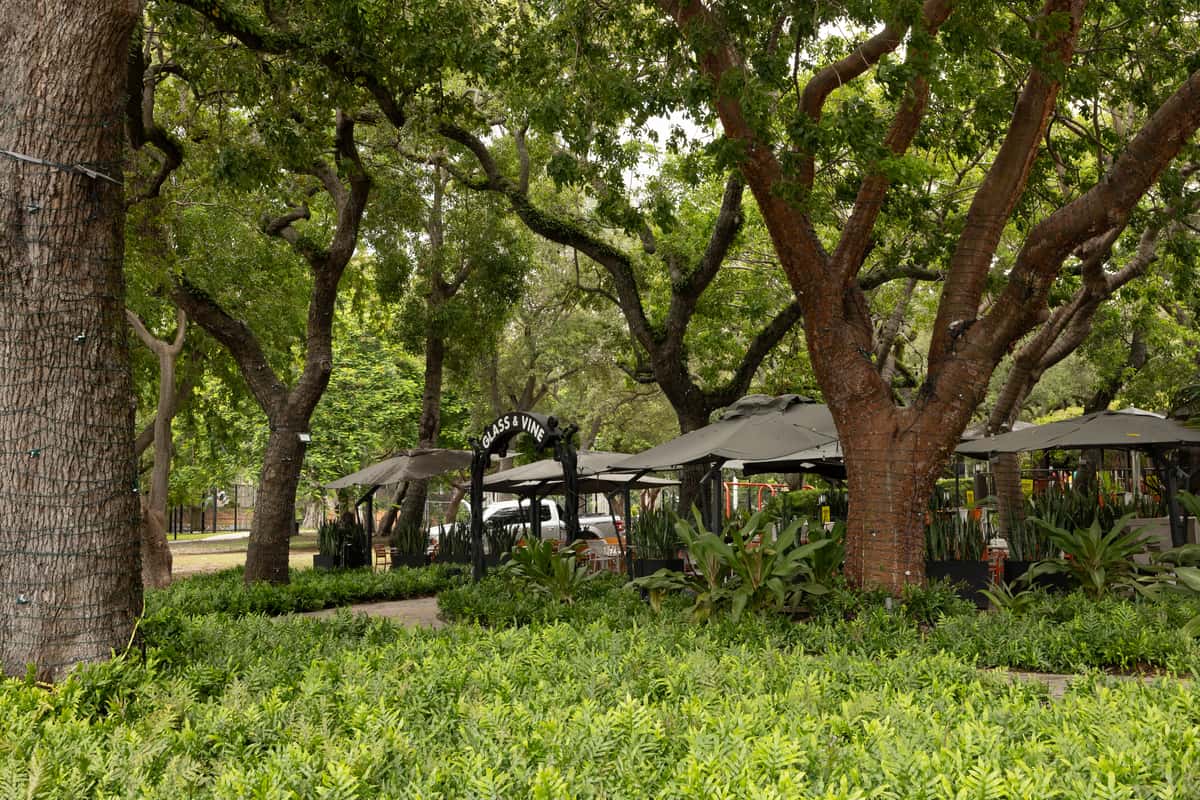
Natural lighting affects food appearance and taste by rendering colors at their true spectrum, which primes the brain to expect stronger flavors. Artificial lighting shifts color temperature, often muting greens and oversaturating yellows, so dishes look less vibrant. Under natural daylight filtered through a canopy, the full visual richness of a plate signals freshness and quality before the first bite.
This visual priming connects to a broader principle: relaxation sharpens taste. Stress can dull the sense of taste, and when diners are relaxed, their brains become more receptive to sensory input, making flavors seem more vibrant and enjoyable. Dappled sunlight through trees contributes to that calm state, effectively pairing visual comfort with heightened palate sensitivity.
How Does Ambient Temperature Outdoors Shift Flavor Intensity?
Ambient temperature outdoors shifts flavor intensity by altering how taste receptors on the tongue respond to food molecules. Warmer conditions increase the volatility of aromatic compounds, so dishes release more scent at the table. Temperature also influences sweetness perception; the ion channel TRPM5, which plays a role in gustatory signaling, shows high temperature sensitivity, helping explain why warm environments can enhance sweet perception. Cooler evening air, by contrast, can sharpen acidity and bitterness while tempering sweetness. In subtropical climates, moderate warmth paired with adequate humidity keeps saliva production steady, ensuring taste buds interact efficiently with dissolved flavor compounds.
With these environmental factors working in concert, the sensory elements found in nature add another powerful layer to outdoor flavor perception.
What Sensory Factors in Nature Enhance the Dining Experience?
Sensory factors in nature that enhance the dining experience include birdsong, tree canopy shade, surrounding greenery, and ambient humidity. Each engages a different sensory channel, shaping comfort and flavor perception through crossmodal interactions.
How Does Birdsong and Natural Sound Affect Meal Enjoyment?
Birdsong and natural sound affect meal enjoyment by lowering stress and creating an acoustic backdrop that supports relaxation during a meal. When the body is calm, the brain processes taste more openly, allowing flavors to register with greater clarity.
Traffic noise and other urban sounds work against this effect. A 2024 study published by the National Center for Biotechnology Information found that anthropogenic soundscapes, including traffic sounds, can mask the positive impact of natural soundscapes, including birdsong, on stress and anxiety. Dining beneath a canopy of trees, where birdsong replaces engine noise, removes that interference. For anyone who has noticed a meal feeling more satisfying in a quiet garden than on a busy sidewalk, auditory environment is a likely reason.
How Does Tree Canopy Shade Create Comfort That Enhances Taste?
Tree canopy shade creates comfort that enhances taste by regulating temperature and activating the body's relaxation response. Neuroscientific research shows that exposure to natural elements, especially organic light and shade, activates the parasympathetic nervous system, reducing stress and promoting calm. This calmer physiological state allows taste receptors to function without the dulling interference of stress hormones.
Dappled light filtering through branches also softens visual glare, reducing sensory fatigue. Because the insula, the brain's primary gustatory area, processes both taste signals and thermal input, physical comfort under shade directly supports how vividly we perceive flavor. Filtered natural light and cooler skin temperature create conditions where each bite registers more fully.
How Does Greenery in Your Visual Field Reduce Stress at Meals?
Greenery in your visual field reduces stress at meals by providing a restorative focal point that lowers psychological tension. Surrounding foliage signals safety to the brain, a response rooted in evolutionary biology, which helps shift the nervous system away from alertness and toward rest.
This visual calm matters for flavor perception because a relaxed diner processes sensory input more richly. When cortisol levels drop, taste sensitivity increases and subtle notes in food become more detectable. Lush landscapes around a dining table do not just look appealing; they actively prepare the palate. In practice, even peripheral greenery contributes to this effect, making park-adjacent settings particularly effective for enjoyable meals.
How Does Humidity in Tropical Climates Influence Palate Response?
Humidity in tropical climates influences palate response by maintaining adequate saliva production, which is essential for taste buds to interact with food molecules. According to CTT Systems, reduced humidity decreases saliva output, making it difficult for taste receptors to dissolve flavor compounds, leading to a blander taste, especially for complex dishes and drinks like wine.
Coconut Grove's naturally humid subtropical air keeps the mouth hydrated throughout a meal, preserving sensitivity to sweet, sour, salty, and umami notes. This is one reason outdoor dining in South Florida often feels more flavorful than climate-controlled indoor alternatives. For diners who value nuanced cuisine, ambient moisture is an underappreciated advantage of tropical garden settings.
Understanding how each sensory channel shapes flavor sets the stage for exploring the broader science of crossmodal perception.
What Does the Science of Crossmodal Perception Reveal About Eating Outdoors?
The science of crossmodal perception reveals that eating outdoors engages multiple sensory modalities simultaneously, and these senses actively reshape how the brain interprets flavor. Crossmodal perception involves interactions between two or more different sensory modalities, meaning what you see, hear, smell, and feel while dining doesn't just accompany taste; each channel modifies it. When you eat beneath a tree canopy, the dappled light filtering through leaves, the texture of a breeze against skin, the scent of surrounding greenery, and the ambient sounds of nature all converge in the brain's multisensory processing centers. Rather than operating in isolation, these inputs blend to create a unified flavor experience that differs measurably from what the same dish would produce indoors. For outdoor restaurants, this science suggests that the environment itself functions as an ingredient, one that can amplify sweetness, soften bitterness, or heighten aromatic complexity depending on the specific sensory conditions present. Understanding crossmodal interactions transforms restaurant design from aesthetics into applied neuroscience, where every environmental detail becomes a lever for shaping how guests perceive each bite.
How Does Biophilic Design in Restaurants Improve Flavor Perception?
Biophilic design in restaurants improves flavor perception by integrating natural elements into the built dining environment, activating sensory and psychological pathways that heighten how guests experience food. This section covers how the design philosophy works, which elements matter most, and why restaurants embracing nature-forward spaces consistently deliver more memorable meals.
Biophilic design applies the principle that humans possess an innate affinity for natural environments. When a restaurant weaves living plants, natural materials, water features, open-air layouts, and organic light into its architecture, it creates conditions where the body shifts into a relaxed parasympathetic state. That physiological calm directly supports sharper taste sensitivity and richer flavor memory.
The mechanism operates on multiple levels simultaneously. Visually, greenery and natural textures reduce cognitive fatigue, freeing mental bandwidth for sensory engagement with food. Acoustically, spaces designed to allow birdsong, rustling leaves, or flowing water replace the harsh clatter of enclosed dining rooms, lowering stress markers that otherwise dull the palate. Thermally, open-air biophilic layouts expose diners to gentle ambient temperature shifts that influence taste receptor activity.
What separates biophilic restaurant design from simply placing a potted plant on a windowsill is the intentional layering of these elements. The most effective spaces combine:
- Living canopy or overhead vegetation that filters natural light into dappled patterns
- Unobstructed airflow carrying garden scents that prime olfactory receptors before the first bite
- Natural ground materials like stone or wood that connect diners to an organic setting
- Proximity to open green space that extends the visual field and deepens the sense of immersion
Professor Charles Spence, head of the Crossmodal Research Laboratory at the University of Oxford, studies how the brain processes information from different senses to form rich multisensory experiences. His research framework confirms that environmental context is not peripheral to flavor; it is a core ingredient. A dish served under a tree canopy, surrounded by garden sounds and natural humidity, activates more sensory channels than the same plate delivered under fluorescent lights on a tile floor.
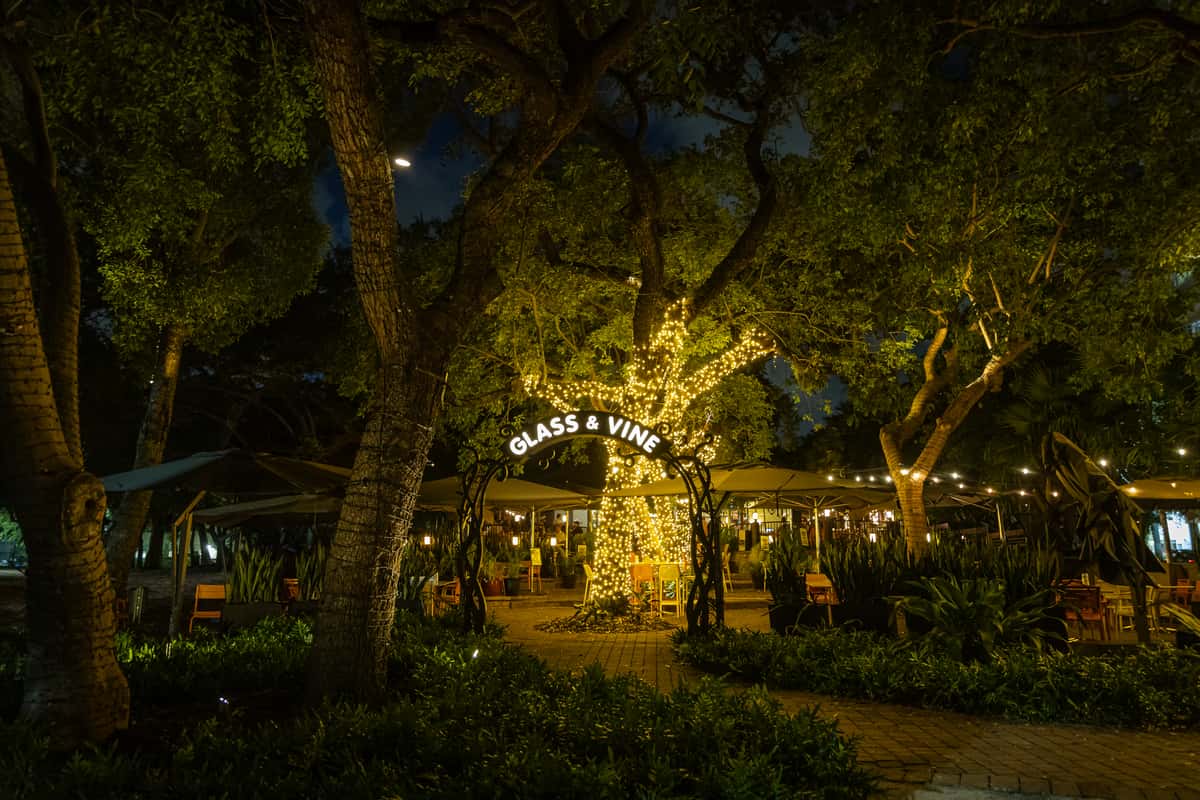
For restaurants in tropical climates, biophilic design holds a particular advantage. Year-round warmth, mature tree canopies, and natural humidity create a baseline environment where taste perception is already primed. The key is designing a space that amplifies rather than fights those conditions. Glass & Vine exemplifies this approach in Coconut Grove, where the restaurant's open-air design leverages the existing oak canopy of Peacock Park rather than imposing artificial structures, creating year-round outdoor dining conditions that work with South Florida's natural climate. This is where biophilic design in restaurants moves from trend to functional strategy: every architectural choice either supports or suppresses the guest's capacity to taste fully.
Understanding this connection reframes how relaxation itself becomes a flavor enhancer.
Why Does Eating in a Relaxed Setting Make Food Taste Better?
Eating in a relaxed setting makes food taste better because lower stress levels sharpen sensory receptors, allowing the brain to process flavor with greater detail. The connection between calm and taste has deep historical roots. Below, reduced cortisol and emotional state each reveal a distinct mechanism.
How Does Reduced Cortisol in Nature Heighten Taste Sensitivity?
Reduced cortisol in nature heightens taste sensitivity by allowing taste receptors, particularly temperature-sensitive ion channels like TRPM5, to function at full capacity. When stress hormones flood the body, sensory processing narrows toward threat detection rather than nuanced flavor recognition.
According to Harvard Health Publishing, spending at least 20 to 30 minutes immersed in a nature setting was associated with the biggest drop in cortisol levels. Once cortisol decreases, the parasympathetic nervous system takes over, increasing saliva production and receptor responsiveness. TRPM5, a key gustatory channel, demonstrates high temperature sensitivity that enhances sweet perception and modulates flavor intensity at elevated temperatures.
For diners seated outdoors beneath a tree canopy, this neurological shift means flavors register more vividly. The combination of lowered stress and natural warmth creates conditions where taste buds operate at their peak sensitivity.
How Does Emotional State During a Meal Shape Flavor Memory?
Emotional state during a meal shapes flavor memory by linking sensory input to the limbic system, where the brain encodes experiences with emotional significance. Positive emotions, such as contentment and social warmth, strengthen the neural pathways that associate specific flavors with pleasurable recall.
When a diner feels relaxed, the hippocampus processes taste alongside contextual cues: the sound of wind through leaves, the scent of surrounding greenery, the quality of natural light. These multisensory details become bundled into a single memory, making the meal more vivid in retrospect. Stress, by contrast, suppresses detailed encoding and leaves only fragmented impressions.
This is why meals eaten in emotionally meaningful settings tend to be remembered as tasting better. The flavor itself may be identical, but relaxation gives the brain permission to fully record and appreciate it. Understanding how environment connects to emotional memory helps explain why outdoor dining traditions stretch back centuries.
How Do Shared Plates and Social Dining Outdoors Amplify Enjoyment?
Shared plates and social dining outdoors amplify enjoyment by combining the psychological effects of communal eating with the sensory benefits of a natural setting. Research reveals that eating with others measurably changes consumption behavior and emotional engagement, while outdoor environments lower stress and heighten flavor perception.
The social facilitation of eating describes a well-documented phenomenon: people dining with others eat more, and often significantly more, than those eating alone. According to a study published by the National Center for Biotechnology Information, this effect reflects deeper social and emotional dynamics rather than simple distraction. When meals become shared experiences, conversation and connection transform eating from a biological act into a source of genuine pleasure.
Outdoor settings intensify this effect. Natural soundscapes, dappled light filtering through tree canopies, and fresh air collectively activate the parasympathetic nervous system, creating a relaxed state where diners linger longer and savor each bite more fully. Shared plates encourage tactile interaction with food, prompting diners to taste more widely and discuss what they are eating. This verbal engagement with flavor, describing a dish's acidity or comparing its texture, reinforces sensory memory and deepens satisfaction.
The combination is greater than either element alone. Communal dining outdoors creates a feedback loop: relaxation from nature encourages open conversation, conversation slows the pace of eating, and a slower pace allows the palate to register subtleties that rushed indoor meals often miss. Dishes designed for sharing, with their variety of flavors and textures, give groups a reason to explore together rather than retreat into individual plates. Glass & Vine in Coconut Grove builds its entire dining philosophy around this principle, offering sharing-style plates designed to encourage communal exploration of flavors beneath the natural canopy of Peacock Park.
For anyone seeking this exact pairing of social warmth and natural atmosphere, Glass & Vine builds its entire dining philosophy around shareable, locally sourced dishes served beneath the oak canopy of Peacock Park in Coconut Grove.
What Role Does Local and Seasonal Sourcing Play in Outdoor Flavor?
Local and seasonal sourcing plays a central role in outdoor flavor by delivering ingredients at peak freshness, when natural sugars, aromatic compounds, and textures are most pronounced. This matters especially in open-air settings, where the surrounding environment already heightens sensory awareness.
When produce travels shorter distances, it retains volatile compounds responsible for aroma, a key driver of flavor perception. Seasonal fruits, herbs, and vegetables harvested at maturity carry more concentrated flavor profiles than out-of-season alternatives shipped from distant regions. In an outdoor dining context, where fresh air and natural scents prime the palate, these differences become more noticeable.
According to the Sustainable Agriculture Research and Education program, local and regional food sales totaled an estimated $6.1 billion in 2012, reflecting growing consumer demand for proximity-based sourcing. That demand is not purely ideological; shorter supply chains preserve the very freshness that makes ingredients taste more vibrant on the plate.
For restaurants in tropical climates like South Florida, seasonal sourcing also means working with ingredients naturally suited to the local terroir. Tropical fruits, seafood pulled from nearby waters, and herbs grown in humid subtropical conditions carry flavor signatures that complement the warmth, humidity, and lush greenery surrounding an outdoor table. The environment and the plate begin to speak the same sensory language.
This alignment between what grows locally and the setting where it is served creates a coherence that diners perceive, even if subconsciously. A mango harvested ripe from a nearby grove and served under a canopy of oak trees tastes more integrated into the moment than one picked green and shipped across continents. For any outdoor restaurant committed to maximizing flavor, local and seasonal sourcing is not a marketing choice; it is a foundational culinary strategy that the surrounding environment rewards.
How Does a Coconut Grove Garden Setting Elevate Your Meal?
A Coconut Grove garden setting elevates your meal by combining mature tree canopies, year-round outdoor dining, and locally sourced cuisine into a single multisensory experience. The sections below explore how Glass & Vine's open-air environment enhances flavor and what key takeaways connect environment to taste.
Can Glass and Vine's Open-Air Garden Dining Enhance Flavor?
Yes, Glass & Vine's open-air garden dining can enhance flavor by immersing guests in the natural sensory conditions that research links to heightened taste perception. Nestled beneath the oak canopy of Peacock Park in Coconut Grove, the restaurant offers year-round outdoor seating surrounded by lush greenery, dappled shade, and natural soundscapes. These elements activate the parasympathetic nervous system, lower cortisol, and prime the palate for richer flavor detection.
Coconut Grove's tropical humidity also supports saliva production, helping taste buds interact more effectively with food molecules. Glass & Vine pairs this environment with locally sourced, sharing-style dishes designed to showcase diverse flavors and textures. The result is a dining experience where setting and cuisine reinforce each other, turning a meal into something closer to what crossmodal research predicts: a place where relaxation, fresh air, and natural beauty genuinely make food taste better.
What Are the Key Takeaways About How Environment Shapes Flavor?
The key takeaways about how environment shapes flavor center on the interplay between sensory input, stress reduction, and crossmodal perception. The most actionable insights from the research include:
- Natural settings lower stress, which sharpens taste. According to Harvard Health Publishing, spending at least 20 to 30 minutes immersed in a nature setting was associated with the biggest drop in cortisol levels. Lower cortisol makes the brain more receptive to flavor.
- Sound matters as much as scenery. Birdsong and natural soundscapes reduce anxiety, while traffic noise masks those benefits and dulls enjoyment.
- Humidity and temperature directly affect taste receptors. Warm, humid conditions support saliva flow and can enhance sweet perception through temperature-sensitive ion channels.
- Crossmodal perception means every sense contributes to flavor. What you see, hear, and feel while eating shapes what you taste.
- Relaxed social dining amplifies enjoyment. Sharing plates in a comfortable outdoor setting combines the psychological benefits of nature with the social facilitation of eating.
For anyone seeking a meal where the environment actively improves flavor, prioritizing restaurants with genuine outdoor settings, natural shade, and locally driven menus is the most practical step. Glass & Vine in Coconut Grove exemplifies this approach, offering an entirely outdoor restaurant where every element of the garden setting is designed to make food taste its best.